Annotated Essay
The annotations to this essay were made using Hypothesis. This portion of the website must be viewed on Chrome. To view these annotations, viewers must download the Hypothesis Chrome Extension. A script to the annotations can be found here. The full text as originally published in The Nineteenth Century can be found here.
THE WILD WOMEN
"No. I
As Politicians"
By Eliza Lynn Linton
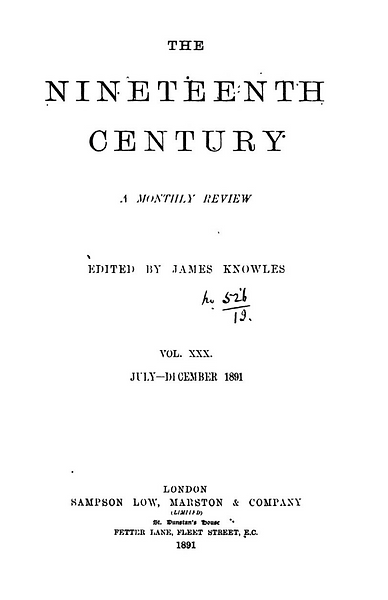
"The Wild Women" No. I As Politicians" was originally published
in The Nineteenth Century, Volume 30 in 1891.
All women are not always lovely, and the wild women never are. As political firebrands and moral insurgents they are specially distasteful, warring as they do against the best traditions, the holiest functions, and the sweetest qualities of their sex. Like certain ‘sports’ which develop hybrid characteristics, these insurgent wild women are in a sense unnatural. They have not ‘bred true' — not according to the general lines on which the normal woman is constructed. There is in them a curious inversion of sex, which does not necessarily appear in the body, but is evident enough in the mind. Quite as disagreeable as the bearded chin, the bass voice, flat chest, and lean hips of a woman who has physically failed in her rightful development, the unfeminine ways and works of the wild women of politics and morals are even worse for the world in which they live. Their disdain is for the duties and limitations imposed on them by nature, their desire as impossible as that of the moth for the star. Marriage, in its old-fashioned aspect as the union of two lives, they repudiate as a one-sided tyranny; and maternity, for which, after all, women primarily exist, they regard as degradation. Their idea of freedom is their own preponderance, so that they shall do all they wish to do without let or hindrance from outside regulations or the restraints of self-discipline; their idea of morality, that men shall do nothing they choose to disallow. Their grand aim is to directly influence imperial politics, while they, and those men who uphold them, desire to shake off their own peculiar responsibilities.
Such as they are, they attract more attention than perhaps they deserve, for we believe that the great bulk of Englishwomen are absolutely sound at heart, and in no wise tainted with this pernicious craze. Yet, as young people are apt to be caught by declamation, and as false principles know how to present themselves in specious paraphrases, it is not waste of time to treat the preposterous claims put forth by the wild women as if they were really serious — as if this little knot of noisy Mænads did really threaten the stability of society and the well-being of the race.
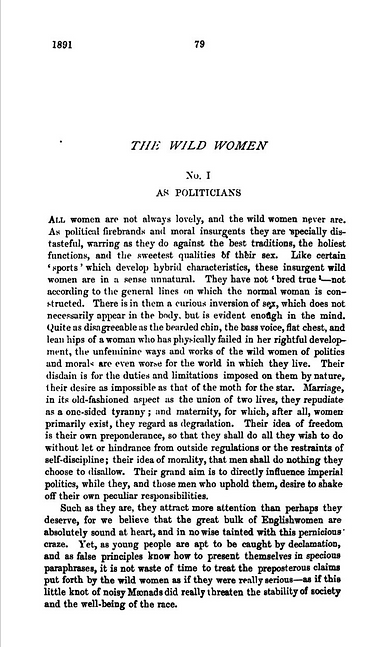
Page 1"The Wild Women" No. I As Politicians,"as originally published
in The Nineteenth Century.
Be it pleasant or unpleasant, it is none the less an absolute truth — the raison d'etre of a woman is maternity. For this and this alone nature has differentiated her from man, and built her up cell by cell and organ by organ. The continuance of the race in healthy reproduction, together with the fit nourishment and care of the young after birth, is the ultimate end of woman as such; and whatever tells against these functions, and reduces either her power or her perfectness, is an offence against nature and a wrong done to society. If she chooses to decline her natural office altogether, and to dedicate to other services a life which has no sympathy with the sex of humanity, that comes into her lawful list of preferences and discords. But neither then nor while she is one with the rest, a wife and mother like others, is she free to blaspheme her assigned functions; nor to teach the young to blaspheme them; nor yet to set afoot such undertakings as shall militate against the healthy performance of her first great natural duty and her first great social obligation.
The cradle lies across the door of the polling-booth and bars the way to the senate. We can conceive nothing more disastrous to a woman in any stage of maternity, expectant or accomplished, than the heated passions and turmoil of a political content; for we may put out of court three fallacies — that the vote, if obtained at all, is to be confined to widows and spinsters only; that enfranchised women will content themselves with the vote and not seek after active office; and that they will bring into the world of politics the sweetness and light claimed for them by their adherents, and not, on the contrary, add their own shriller excitement to the men’s deeper passions. Nor must we forget that the franchise for women would not simply allow a few well-conducted, well-educated, self-respecting gentlewomen to quietly record their predilection for Liberalism or Conservatism, but would let in the far wider flood of the uneducated, the unrestrained, the irrational and emotional — those who know nothing and imagine all — those whose presence and partisanship on all public questions madden already excited men. We have no right to suppose that human nature is to be changed for our benefit, and that the influence of sex is to become a dead letter because certain among us wish it so. What has been will be again. In the mirror of the prophet, which hangs behind him, the Parisian woman of the Revolution will he repeated wherever analogous conditions exist; and to admit women into active participation in politics will certainly be to increase disorder and add fuel to the fire of strife.
We live by our ideals. Individually they may fall into the dust of disappointment, and the flower of poetic fancy may wither away into the dry grasp of disillusion. Nevertheless the race goes on cherishing its ideals, without which, indeed, life would become too hard and sordid for us all. And one of these ideals in all Western

Page 2"The Wild Women" No. I As Politicians,"as originally published
in The Nineteenth Century.
countries is the home. Home means peace. It means, too, love. Perhaps the two are, synonymous. In the normal division of labour the man has the outside work to do from governing the country to tilling the soil; the woman takes the inside, managing the family and regulating society. The more highly civilised a community is the more completely differentiated are these two functions. In the lower strata of society the women work in the fields with the men; but as yet we have not had handsome young lady cornets in the army, nor stalwart gentlemen occupied with the week’s wash and Mary-maid’s demands for Turk’s heads and house-flannels.
Part of this ideal of home is the rest it gives the man when he returns to it after a hard day’s work in the open — a hard day’s struggle in the arena. Here his thoughts drift into a smoother channel, his affections have their full outlet and to his wife and children he brings as much happiness as he receives. The darker passions which the contests of life arouse are shut out; the sweeter influences of the family, the calmer interests of the intellect, the pleasures of art and society remain. We are speaking of the ideal, to which we all in some sort aspire, and in which we believe — for others if not for ourselves. When we have come, to think of it as mere moonshine we have achieved our own spiritual death; when we have acted and legislated as if it were moonshine we have decreed our national degradation.
But where will be the peace of home when women, like men, plunge into the troubled sea of active political life? Causes of disunion enough and to spare exist in modem marriage. We need not add to them. More especially we need not add to them by introducing a new and quite unnecessary wedge into brittle material of which highly strained nerves and highly developed tastes, with complexity of personal interests, have already destroyed the old cohesive quality. Imagine the home to which a weary man of business, and an ardent politician to boot, will return when his wife has promised her vote to the other side, and the house is divided against itself in very truth. Not all husbands and wives wear the same badge, and we all know miserable cases where the wife has gone directly and publicly counter to the husband. If these things are done in the green tree of restricted political action, what would happen in the dry of active political power? Women are both more extreme and more impressible than men, and the spirit which made weak girls into heroines and martyrs, honest women into the yelling tricoteuses of those blood-stained saturnalia of ’92, still exists in the sex; and among ourselves as elsewhere.
The dissension that the exercise of this political right would bring into the home is as certain as to-morrow’s sunrise. Those who refuse to see this are of the race of the wilfully blind, or of that smaller sect of enthusiasts who believe in a problematical better rather

Page 3"The Wild Women" No. I As Politicians,"as originally published
in The Nineteenth Century.
than an established good. It is also part and parcel of the temper which desires looseness of family ties and extreme facility for divorce.
Of the wild women who make this disordering propaganda many are still Christians in some form or another — some believing that Christ was the actual living God Incarnate, others that He was a messenger from God, divinely inspired and directly appointed to teach men the way of holy living. And of His (the Master’s) utterances none is more emphatic than this on marriage: 'He which made them at the beginning made them male and female, and said for this cause shall a man leave his father and mother and shall cleave to his wife, and they twain shall be one flesh.' Of His doctrine, nothing is more strenuously insisted on than the sweet and patient self-control which in non-essentials we call courtesy and in higher matters humility, patience, unselfishness, love. How do the women who still call themselves Christians reconcile the two positions? How can they in one breath exalt the character and the mission of Christ, and in the next deride the essential meaning of His teaching? The frank agnostic may prefer to begin from the beginning, and to examine the whole structure of society as a simple matter of evolution and experience; but these wild women are not all frank agnostics; they are rather of that curious family which thinks, to hold with the hare and hunt with the hounds, changing sides according to fancy and the exigencies of the moment. But the demand for these political rights, which would prove true dragons’ teeth granted, is, of all modern things, the most anti-Christian that can be named — the most destructive of home peace and conjugal union, of family solidarity and personal love.
In this last word lies the core and kernel of the whole question. This clamour for political rights is woman’s confession of sexual enmity. Gloss over it as we may, it comes to this in the end. No woman who loves her husband would wish to usurp his province. It is only those whose instincts are inverted, or whose anti-sexual vanity are insatiable, who would take the political reins from the strong hands which have always held them to give them to others — weaker, less capable, and wholly unaccustomed. To women who love, their 'desire is to their husbands'; and the feeling remains as an echo in the soul when even the master voice is silent. Amongst our most renowned women are some who say with their whole heart, I would rather have been the wife of a great man, or the mother of a hero, than what I am — famous in my own person.’ A woman’s own fame is barren. It begins and ends with herself. Reflected from her husband or her son, it has in it the glory of immortality — of continuance. Sex is in circumstance as well as in body and in mind. We date from our fathers, not our mothers ; and the shield they won by valour counts to us still for honour. But the miserable little mannikin who creeps to obscurity, overshadowed by his wife’s glory, is as pitiful in

Page 4"The Wild Women" No. I As Politicians,"as originally published
in The Nineteenth Century.
history as contemptible in fact, 'The husband of his wife' is no title to honour; and the best and dearest of our famous women take care that this shall not be said of them and theirs. The wild women, on the contrary, burke their husbands altogether; and even when they are not widows act as if they were.
The young who are wavering between the rampant individualism taught by the insurgent sect and the sweeter, dearer, tenderer emotions of the true woman would do well to ponder on this position. They cannot be on both sides at once. Politics or peace, the platform or the home, individualism or love, moral sterility or the rich and full and precious life of the nature we call womanly — married or single, still essentially womanly — they must take their choice which it shall be. They cannot have both. Nor can they have the ruder, rougher privileges’ they desire in this identity of condition with man, and retain the chivalrous devotion, the admiration, and the respect of men. These are born of the very differences between the sexes. If men want the support of equality in friendship, they find that in each other; if they want the spiritual purification which goes with true and lofty love, they look for that in women. When women have become minor men they will have lost their own holding and not have gained that other.
It may be said that certain men support this movement, of whom some may be poor creatures, but others are manly and chivalrous enough. But where was the movement yet that had not its apostles together with its camp followers? Among the small section of men who uphold this new heresy many have that large carelessness of good-nature, that indifference of self-confidence, which makes the giant submit to the dwarf. 'It pleases them and does not hurt us,’ they say. 'If women want the suffrage give it to them in Heaven’s name. We shall always be the stronger, whether or no.’ Others go in for the unworkable theory of abstract justice, independent of general expediency; and the third lot consists of those effeminated worshippers who wrap themselves round in the trailing skirts of the idol and shout for her rights, because they are not virile enough to respect their own. These are specially the men who uphold the imposture of the New Morality, which may be translated into prurience for the one part, and jealousy for the other.
The one unanswerable objection to the direct political power of woman is that grim blood-tax which they cannot pay and men must. The State can call on any man to serve under arms if need be, and that need might easily be brought about by a war voted by those who are themselves exempt from its personal consequences. It is mere 'havers,’ as the Scotch say, to hold that women would necessarily be on the side of peace. Some of the worst wars with which Europe has been afflicted have been brought about by women. Was Madame de Maintenon the advocate for peace? Had the Empress Eugénie

Page 5"The Wild Women" No. I As Politicians,"as originally published
in The Nineteenth Century.
no part in that delirious cry ‘À Berlin!’ which cost so much blood and treasure? Are there no Nihilists, preaching assassination and wholesale murder, to be found among young and beautiful Russian women? From the days of Judith onwards to our own has the world ever wanted for women with hearts of fire and wrists of steel burning to avenge and self-consecrated to strike? More hysterical and still more easily excited than the mob proper, a crowd of women can be stirred by passionate appeals as willow leaves are stirred by the wind. True moutons de Panurge , they will follow their leader, foreseeing no consequences, conscious of no danger; and peace would be no more assured under the monstrous regimen of women than it is now. The men, however, would have to do the work which the women had cut out, and the blood-tax would be voted by those who had naught to contribute. For we put aside the childish argument, ‘We send our husbands and sons,’ as unworthy of serious consideration. Nor is that other answer which is meant to be parallel, ‘We run as much risk in childbed as you do in battle,’ of more validity. It is not women only who have family ties and personal affections. The men who fall leave men as well as women to mourn them; and women need not, if they do not wish, bear children at all. Each individual man is obliged to fight if called on by the State; no individual woman need be a wife or mother if she does not like.
Such political women as the world has seen have not all been desirable. Some have earned the blue riband of renown ; but these have been women who have influenced, not ruled. The charm and grandeur of Aspasia still illumine the historic past and vivify the dead pages ; but en revanche the silly pretensions of those Athenian woman’s rights women who, under Praxagora, were going to make a new law and a new human nature, are in a manner archetypal of all that has come after. In France, where women have always had supreme influence, so that the very blood and marrow of the nation are feminine — not effeminate — the political woman has been for the most part disastrous. Some bright exceptions shine out on the other side. Agnes Sorel, like Aspasia, was one of the rare instances in history where failure in chastity did not include moral degradation nor unpatriotic self-consideration; and Joan of Arc is still a symbol for all to reverence. But of the crowd of queens and mistresses and grandes dames who held the strings and made kings and statesmen dance as they listed, there is scarcely one whose work was beneficent. Even Madame Roland did more harm than good when she undertook the manipulation of forces too strong for her control, too vast for her comprehension. Had there been less of the feminine element in those cataclysmic days perhaps things would not have reached the extremes they did. Had Louis had Marie Antoinette’s energy, and Marie Antoinette Louis’s supineness, the whole story of the Reign of Terror, Marat, Charlotte Corday, and, Napoleon might never have been written.

Page 6"The Wild Women" No. I As Politicians,"as originally published
in The Nineteenth Century.
By the very nature of things, by the inherent qualities of their Bex — its virtues, defects, necessities — women are at once tyrannical and individual. In America, when they get the upper hand, they wreck the grog-shops a and forbid the sale of all liquor whatever. And these women who thus destroy a man’s property and ruin his fortunes in their zeal for sobriety may saturate themselves with tea, ether, or chloral, to the destruction of their health and nerves. They may resort to all sorts of perilous experiments to prevent unwelcome results; — but these are their own affairs and the men have no right to interfere.
This tyrannous temper is part of the maternal instinct which women have inherited for such countless generations. No authority in the world is so absolute, so irresponsible, as that of a mother over her young children. She can make or mar them, physically and morally, as she will — as she thinks best? Even in the most highly civilised communities, where the laws ate strictest and most vigilant, she can, if she so chooses, doom them to death by her bad management, or educate them on such false lines as lead to moral depravity. By the depth and strength of the maternal instinct is the race preserved, and by this alone; and the absolute authority of the mother is the child’s safest shield.
But this very characteristic is fatal to political life, to generalised justice, to the suppression of sections for the good of the whole. The political woman repudiates all this as so much paltering with the Evil One. The general good is nowhere when compared with partial inconveniences. We have seen this notably exemplified in our own generation, when excited partisanship put its hand to the plough, rooting out wise legislation on the one hand and sowing poisonous immunities on the other. And so it will ever be with women while they retain their distinctive womanly qualities.
If we imagine for a moment what the woman’s vote would give, and what it would do, we shall see the inherent absurdity of the proposal. To begin with, the confining of the vote to the husbandless is, as we have said, an impossibility. If it is a right conferred by citizenhood, property, and taxation, why should marriage carry with it the penalty of disfranchisement? The Married Woman’s Property Act and the fact that a wife is the mistress of her own property, however acquired or conditioned, reduces this disfranchisement to an injustice as well as an absurdity. Nor, as was said, can the vote be confined to the capable and educated. All the little country shopkeepers and work women who know nothing beyond the curate, the church, the school feast, and the last new local baby; the laundress who cannot manage her unruly half-dozen hands; the rollicking landlady. who would give her vote dead sure to the jolly candidate who drank his bottle like a man and paid for it like a prince; the widow with no more knowledge of men and life than to keep her boy like a little girl tied to

Page 7"The Wild Women" No. I As Politicians,"as originally published
in The Nineteenth Century.
her apron-string; the ‘lodger’ with her doubtful antecedents and loss doubtful profession; all the good, weak, innocent women who know no more of politics than so many doves in a cage; all the wild, excited, unreasoning women who think that vice and virtue, misery and prosperity, anew human nature and a new political economy can be made by Act of Parliament — all these sending the majority to decide on taxes, wars, treaties, international questions of difficulty and delicacy! — all these directly influencing the imperial policy of our grand old country! And the men who stand by, tongue in cheek, laughing at the sorry farce they do not take the trouble to check, or who, woman-lovers to the point of self-absorption and Sexual idolatry, believe, with the women themselves, that this preponderance will really be the beginning of a new era in national virtue! And all the while these wild women and their backers shut their eyes to the contempt with which other nations would regard us. Even France, for all her feminine qualities, has not done so mad a thing as this. Even France has not proposed to enfranchise her lionnes and lorettes — to admit into the Senate the direct personal power of the courtesan. It is reserved for England — the fad-ridden England of these later days — to hear in her Parliament this proposal to be hag-ridden; for that is simply what it would come to. The womanly women would retire or be pushed aside by the wild women, the small but noisy section which there is yet time to ignore or to suppress.
Doubtless there are few women of anything like energy or brain power who have not felt in their own souls the ardent longing for a freer hand in life. Men as a race are the stronger and the more capable, but every man is not every woman’s superior; and women of character do not find their masters at all street comers. But if they have common sense and are able to judge of general questions, and not only of individuals, they know that to upset present political conditions for the admission of a few exceptions would be disastrous to the well-being of society as to obliterate all other distinctions of sex.
This question of woman’s political power is from beginning to end a question of sex, and all that depends on sex — its moral and intellectual limitations, its emotional excesses, its personal disabilities, its social conditions. It is a question of science, as purely as the best hygienic conditions or the accurate understanding of physiology. And science is dead against it. Science knows that to admit women — that is, mothers — into the heated arena of political life would be as destructive to the physical well-being of the future generation as it would be disastrous to the good conduct of affairs in the present. And social science echoes the same thing in all that regards wives and mistresses of honest families. As for the self-complacent argument that women would moralise politics, can anyone point out

Page 8"The Wild Women" No. I As Politicians,"as originally published
in The Nineteenth Century.
Page 9"The Wild Women" No. I As Politicians,"as originally published
in The Nineteenth Century.
anywhere a race of women who are superior to their conditions? What is it that gives women their peculiar moral power over men but the greater purity born of their greater ignorance — their daintier refinement, because of their more restricted lives? Frankly, do young men respect most the young women who have read Juvenal and Petronius and those other classics of which their mothers, God bless them! did not know even the names, or those others whose innocent eyes have never yet been darkened or hardened by a knowledge of the shameful sins of life? When women have all in common with men will they retain aught of their distinctive beauty? Where do we find that they do? Are the women at the gin-shop bar better than the men at the gin-shop door — the field hands in sun-bonnets more satisfactory than those in brimless hats? If women are intruded into the political world with all its angry partisanship and eagerness for victory, how can they retain the ideal qualities which they have gained by a certain amount of sequestration from the madding crowd’s ignoble strife? Are they alone, of all created things, uninfluenced by their environment, incapable of reversion to the lower original type? We may be sure that the world has done well for itself in the distinctions of habit that it has made in all ways between the sexes, and that those who would throw down the barriers are letting in the flood. But ‘après nous le déluge !’ The wild women who would scramble for the sceptre of political sovereignty have no great regard for the future or anything else but themselves. ‘Let us enjoy, no matter who suffers ; crucify the old ideal, and let our children run the risk.’
These words lead us back to the centre of the moral objections against the active political woman. It may be that the Christian ideal, the Christian doctrine, is a myth and a dream from start to finish. Be it so; but if so, let it be acknowledged. If indeed those sweet and lovely virtues of patience and unselfishness are follies, let the world confess it and make no more pretence to the contrary. If, however, they still have any significance, and are held by many as of divine authority, it seems rather self-contradictory that the half of the race which can best practise them refuses to do so, and would lay the burden on the shoulders of those to whom they are not always either righteous or possible. A fighter cannot be non- resisting; but we need not all be fighters, men and women indiscriminately. The gentle response of the Jewish women to the men’s prouder boast of their material advantages has always seemed to is to carry in it the very soul of womanly sweetness. ‘We thank Thee, O Lord God, that Thou hast made us according to Thy will.’
Well! whether it be according to the directly spoken will of God, or according to the mysterious law of evolution, working we know not whence, tending we know not whither — let it be by religion or by nature, society or science — there stands the fact four-

Page 10 "The Wild Women" No. I As Politicians,"as originally published
in The Nineteenth Century.
square, the grand fundamental fact of humanity, difference of sex, and consequent difference of functions, virtues, qualities, and qualifications. As little as it is fitting for a man to look after the pap boat and the house linen, so is it for women to assume the political power of the State. Our men are not yet at such a low ebb in brains or morals as to need dispossession; nor, pace our platform orators, are the wild women, though undeniably smart, of such commanding intelligence as to create a new epoch and justify a new social ordering.
By the grace of good luck the question has been shelved for the present session, but the future is ahead. And as, Unfortunately, certain of the Conservative party coquet with the Woman’s vote, believing that. they shall thus tap a large Conservative reservoir, we are by no means clear of the danger. What we would wish to do is to convince the young and undetermined that political work is both unwomanly and unnatural; self-destructive and socially hurtful; the sure precursor to the loss of men’s personal consideration and to the letting loose the waters of strife; and — what egotism will not regard — the sure precursor to a future regime of redoubled coercion and suppression.
For, after all, the strong right arm is the ultima ratio, and God will have it so; and when men found, as they would, that they were outnumbered, outvoted, and politically nullified, they would soon have recourse to that ultimate appeal — and the last state of women would be worse than their first.
E. Lynn Linton.
